
What Mother Goose Left Behind
Before bedtime stories, before picture books, before literacy itself, there were rhymes. A deep look at the woman who wasn't one person, the collection that wasn't one book, and the tradition that quietly built the architecture of childhood reading.
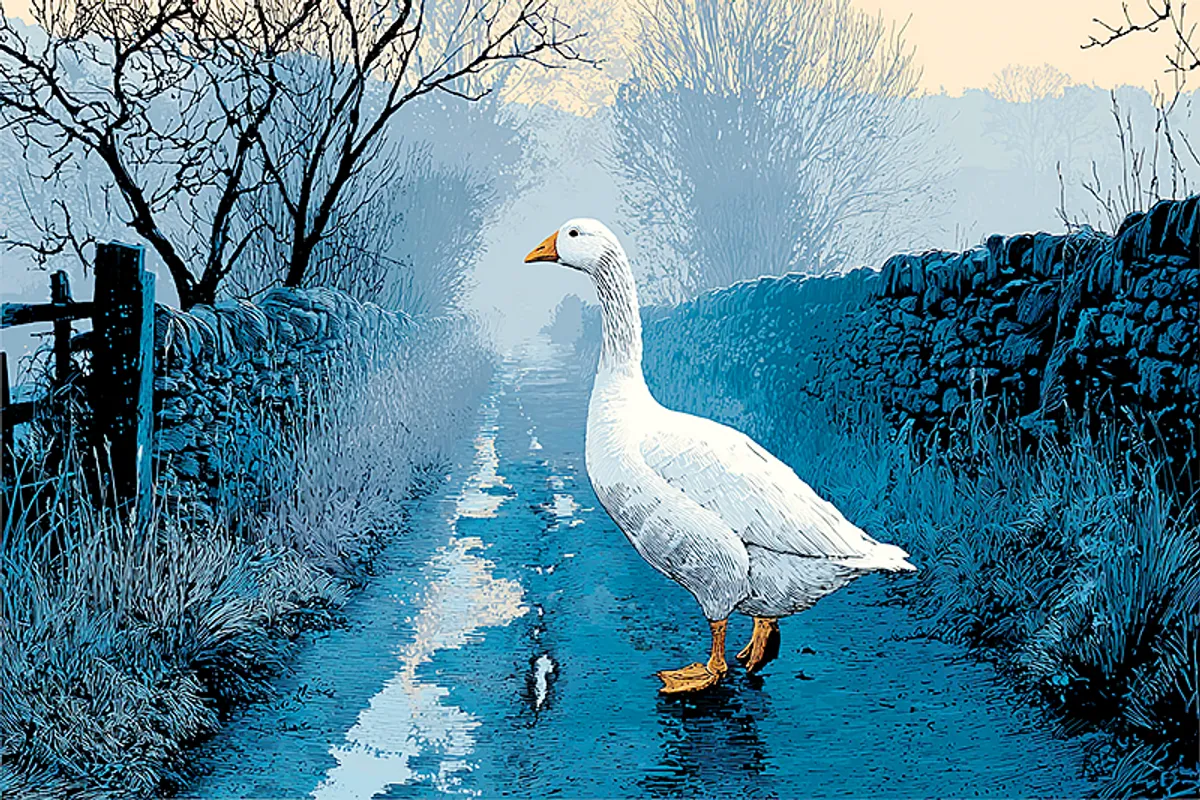
Something gets into you early. Before you understand it. Before you would call it a poem or a rhyme or literature. Before you know what a tuffet is, you know about the spider. Before you understand what a wall could mean, you know about Humpty.
The words arrive whole, already memorized, as if they bypassed learning entirely and went straight to the part of the brain that knows things without knowing how.
That is the achievement of Mother Goose. Not a book, not a woman, not a brand. A transmission.
Before the Page, There Was the Voice
Most of what we call Mother Goose rhymes were never written down when they began. They lived in mouths. Passed from nurses to children, from grandmothers to grandchildren, from the hired girl to the baby she was minding on a Tuesday afternoon in the 1650s.
The oral tradition that eventually became the Mother Goose canon drew from working-class adult song, street chants, counting games, political satire, lullabies, and the kind of rough irreverent humor that adults use when they think small children aren’t paying attention. Children paid attention.
“Cock a Doodle Doo” can be traced to print in the late 1500s. “To Market, To Market” appears in roughly the same period. But traces in print are late evidence of things that were already old. These rhymes existed in the oral bloodstream of English-speaking culture for generations before anyone thought to capture them.
What they had in common was structure. Tight rhythmic structure. The kind that enters the ear and stays there whether or not you invited it to.
The Woman Who Was Never One Woman
The name predates any individual person who might have claimed it.
As early as 1638, a French text uses the phrase “Ma Mère l’Oye” as a casual aside, used with the expectation that readers would understand it without explanation. In 1650, the poet Jean Loret wrote about something being “like a Mother Goose story,” indicating the term was already proverbial. A cultural shorthand for a very particular kind of tale.
In 1697, Charles Perrault published Histoires ou contes du temps passé under his son’s name, with the subtitle Contes de ma mère l’Oye. This is the first formal use of the name in publishing history, and the collection contained not a single nursery rhyme. It contained Cinderella, Sleeping Beauty, and Little Red Riding Hood. The nursery rhyme association came later, in a different language, from a different publishing tradition.
The English pivot happened around 1765, when John Newbery (the same publisher whose name now graces the most prestigious award in American children’s literature) issued Mother Goose’s Melody: or Sonnets for the Cradle. Newbery packaged 51 rhymes as “the most celebrated Songs and Lullabies of the old British Nurses.” The earliest surviving copy dates to 1784. This slim volume cemented what “Mother Goose” would mean in English: not fairy tales, but verse. Not narrative, but rhythm.
Then there is the Boston legend.
In 1860, nearly a century after Newbery and 150 years after the supposed events, a man named John Fleet Eliot claimed that his great-grandmother Elizabeth Foster Goose of Boston had published the original Mother Goose collection in 1719. No copy of this book has ever been found. No contemporary account corroborates it. Historians have traced the story to Fleet Eliot’s own pen, and the scholarly consensus is unambiguous: the story was invented to give a gravestone in Boston’s Granary Burying Ground some tourist appeal.
It worked, for a while.
Mother Goose was never one woman. She was, as the great nursery rhyme scholars Iona and Peter Opie concluded after a lifetime of research, a name that belonged to everyone. Which is to say, a name that belonged to the tradition itself.
What the Rhymes Were Actually Doing
In 1989, psychologists Peter Bryant, Lynette Bradley, Morag MacLean, and Jane Crossland published a study that would become a cornerstone of early literacy research. Over three years, they followed 64 children from age three into early schooling.
Their finding was stark.
Children who knew more nursery rhymes at age three performed significantly better on reading and spelling tests at age six. Not marginally better. Significantly and independently better, even after controlling for IQ, social background, and phonological skill at the start of the study.
The mechanism was phonological awareness: the ability to hear and manipulate individual sounds within words. Nursery rhymes, with their compressed rhythms, their insistent rhymes, their alliterative clustering (Peter Piper, Sing a Song of Sixpence, Wee Willie Winkie), train the ear to hear language as sound before the brain must deal with it as meaning. They are, in the most literal sense, pre-literacy exercises.
This is not how we usually think about them. We think of nursery rhymes as charming, as nostalgic, as the kind of thing we recite without thinking. But the research is unambiguous: a child who arrives at school with Hickory Dickory Dock already in their bones is a child whose auditory cortex has been doing preparatory work.
The rhymes don’t teach children to read. They prepare the neural ground for reading to take root. There’s a difference, and it matters.
What comes next matters too. The step from shared oral tradition to a story that feels personally true is where literacy and identity begin to converge. The rhyme gets in early. But the story that feels like yours, that carries your name and reflects your face, is the one that stays longest.
The Myths We Made
Here is something interesting about nursery rhymes: we cannot leave them alone.
We keep trying to give them dark histories. The most persistent is the plague theory for “Ring Around the Rosie.” The claim is that the rosy ring is a plague rash, the posies are herbs carried against infection, the sneezing is a symptom, and “we all fall down” is death. Generations of children have been told this. Teachers repeat it.
It is almost certainly false.
“Ring Around the Rosie” does not appear in print until 1881, in Kate Greenaway’s illustrated Mother Goose edition. The plague connection was first articulated in print in 1961. No commentator in the eighty years between the rhyme’s first publication and that interpretation ever mentioned it. The Library of Congress classifies this theory as “metafolklore”: a story invented about a story, mistaken for history.
The Humpty Dumpty cannon theory follows a similar pattern. The claim is that Humpty Dumpty was a Royalist cannon that toppled from a wall during the 1648 Siege of Colchester. The rhyme doesn’t appear in print until around 150 years after the siege. The Colchester connection was first asserted in the 1980s, another 200 years after the rhyme appeared. No contemporary account names any cannon “Humpty Dumpty.” The egg came from 19th-century illustrators, not from the original text, which was simply a riddle.
We make these histories because we find it hard to believe that something so deeply embedded in culture could be purely structural. Surely the rhymes must mean something, must point somewhere.
But the original function was simpler and more powerful: to make sound memorable, to make rhythm physical, to give small ears something to practice on.
They worked before they meant anything. That is the point.
The People Who Gave Her a Face
The figure of Mother Goose herself, an old woman in a tall hat, sometimes literally astride a goose, was not ancient. She was Victorian.
The trio of illustrators who defined nursery rhyme culture in the 1870s and 1880s, Kate Greenaway, Randolph Caldecott, and Walter Crane, gave the tradition its visual identity. Greenaway’s 1881 Mother Goose, with its delicate children in period costume and soft pastoral light, established the idealized aesthetic that still influences how we picture the nursery rhyme world. Caldecott’s work in the same period was so foundational that the most prestigious children’s book illustration award in America bears his name: the American Library Association established the Caldecott Medal in 1938 precisely because they recognized that nursery rhyme illustrators had set the standard by which all children’s book art would be measured.
Arthur Rackham’s 1913 Mother Goose was different: darker, stranger, more intricate. Where Greenaway’s children were orderly and serene, Rackham’s illustrations carried a slightly unsettling energy, as if the old world just beneath the nursery rhymes were closer to the surface than the words let on.
The most commercially durable edition came from Blanche Fisher Wright, whose Real Mother Goose (1916) has remained in print continuously. It is probably the version most Americans of the twentieth century encountered first. Simple, bright, unmistakable.
These artists did not inherit the visual tradition. They invented it. The rhymes were already old; the pictures were new. Children encountered both as if they had always belonged together, which is the best thing you can say about any collaboration between text and image.
What Stays
A child learns “Jack be nimble” at two years old. At twelve, they will not remember learning it. At forty-five, they will still know it. The meter will still be there, the way certain things are there, not as information but as structure. Like knowing where the doors are in your childhood home in the dark.
That is the real bequest. Not the stories, not the characters, not even the lessons. The bequest is an ear trained to hear how language sounds before meaning arrives. A readiness for pattern. A body that has known rhythm longer than it has known syntax.
Mother Goose didn’t write any of this down. She wasn’t one person. She didn’t even have a face until the Victorians painted one for her.
But something got into you early, before you understood it, before you had any mechanism to explain it. Something bypassed the ordinary processes of learning and went straight to the place where things just live.
That is still her work.
Frequently Asked Questions
Was Mother Goose a real person? No, and the most famous candidate, Elizabeth Foster Goose of Boston, is a fabrication from 1860 that has never been supported by a single primary source. The French origin of the name predates her by more than two centuries. The scholarly consensus, led by nursery rhyme authorities Iona and Peter Opie, is that “Mother Goose” was never one person but rather a name that attached itself to the oral storytelling tradition itself.
Who published the first Mother Goose in English? John Newbery (whose name the Newbery Medal now honors) published Mother Goose’s Melody: or Sonnets for the Cradle around 1765; the earliest surviving copy dates to 1784. This was the book that permanently linked the “Mother Goose” name to nursery rhymes in English. Before this, the name was associated with Charles Perrault’s 1697 French fairy tale collection, which contained no nursery rhymes at all.
Is “Ring Around the Rosie” really about the Black Death? Almost certainly not. The rhyme doesn’t appear in print until 1881. The plague interpretation wasn’t published until 1961. No pre-WWII commentator ever suggested the connection, despite the rhyme having been widely known for eighty years by then. The Library of Congress classifies this theory as “metafolklore,” a story invented about a story and mistaken for history.
Do nursery rhymes actually help children learn to read? Yes, and the evidence is substantial. A landmark 1989 Oxford study by Bryant, Bradley, MacLean, and Crossland followed children from age three to six and found that nursery rhyme knowledge at age three predicted reading and spelling performance at age six, independently of IQ and social background. The mechanism is phonological awareness: the ability to hear and manipulate sounds within words, which nursery rhymes build before a child has ever encountered a letter.
How many Mother Goose rhymes are there? The Oxford Dictionary of Nursery Rhymes, compiled by Iona and Peter Opie, catalogues over 550 entries. The Roud Folk Song Index, the definitive database of traditional English-language folk song, tracks approximately 25,000 distinct songs (including nursery rhymes) with over 250,000 recorded variants from oral tradition worldwide. No single canonical count exists because the tradition was never fixed.
Which nursery rhymes have documented real-world origins? Very few. The most securely documented is “Mary Had a Little Lamb,” published in 1830 by Sarah Josepha Hale and based on an actual incident involving Mary Elizabeth Sawyer of Sterling, Massachusetts. The authorship of the verse itself remains disputed: both Hale and Sawyer signed sworn statements claiming credit, and neither backed down. Most other “real history” claims (Humpty Dumpty as a siege cannon, Jack and Jill as French royalty, Baa Baa Black Sheep as a wool tax protest) lack any contemporary documentation and should be treated as entertaining folklore rather than history.
Why is the Caldecott Medal named after a nursery rhyme illustrator? Randolph Caldecott was a Victorian illustrator whose work on nursery rhyme collections in the 1870s and 1880s established the visual language of the picture book as a form. When the American Library Association created its annual award for best-illustrated children’s picture book in 1938, they named it after Caldecott in direct acknowledgment that the standard for children’s book art had been set by the people who first illustrated Mother Goose.

20% off your first book.
One email. One code. No pressure.
We respect your inbox. Unsubscribe anytime.
Read Next
The Christening Gift That Outlasts Everything Else on the Table
Silver frames tarnish. Money goes in a bank account and disappears. But a personalized book given at christening is the beginning of a story — literally. It's there on the shelf twenty years later, a record of who this child was the day they were named.
The Personalized Book for the Child Who's About to Become a Big Sibling
A new baby changes everything — for the baby, yes, but especially for the child who was there first. A book that makes them the hero of this exact transition does something no 'welcome baby' book can.
A Personalized Book for the New Baby: The Birth Gift That Grows With Them
A new baby arrives without a story. A personalized book is the first story anyone has ever told specifically about them — written before they can read it, kept until they can.