
The Book That Actually Competes With the Screen
Most children's books don't stand a chance against a tablet. A personalized book does something different — it makes the child the star. And children will put down a screen for a chance to see themselves as the hero.
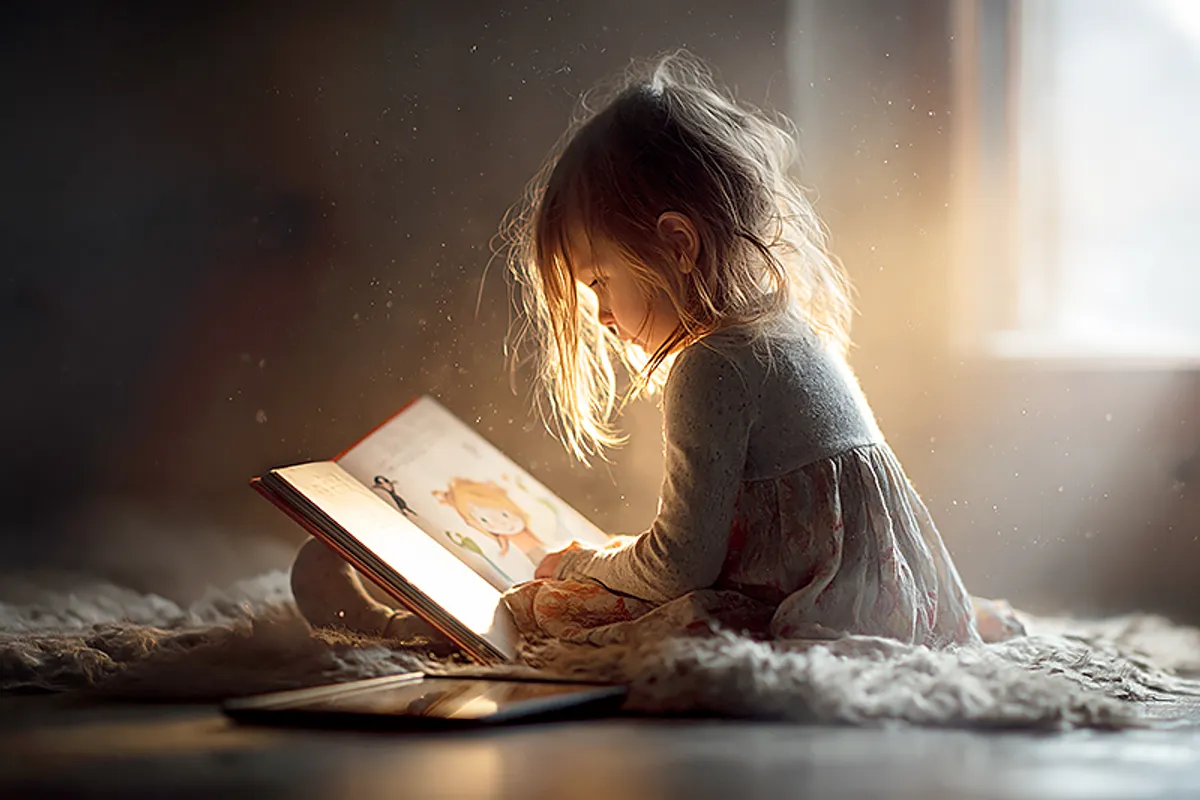
The screen has an unfair advantage.
It moves. It responds immediately. It plays music and voices and colors. It offers an infinite queue of stimulation, calibrated by algorithms that have studied what makes small children keep watching. Against this, a static page with ink on paper is fighting with one hand behind its back.
And yet.
There is one thing a personalized book does that no screen can match: it puts the child in the story. Not a character they identify with. Not a protagonist with similar hair. The child, in a personalized storybook with their face, their name, their world — rendered in illustration and given an adventure worth having.
Children will put down a screen for this. Not every time, not without effort, but more reliably than almost anything else. The reason is not complicated: self-recognition is more powerful than any algorithm. A child who finds themselves in a book is discovering something the screen cannot offer — that stories can be about them, specifically, and not just about someone else they’re watching.
Why the Screen Usually Wins
It’s worth being honest about why screens are so effective before pretending books are an easy alternative.
Screens are designed by professionals who study attention and optimize for engagement. The feedback loop is instant — press a button, something happens. The content is personalized automatically, not by craft but by data. The experience requires no effort to begin: the show is already rolling when the child picks up the tablet.
Books, by contrast, require a child to do most of the work. They must imagine the voice, the movement, the sound. A good book scaffolds this — good illustration and good prose give children what they need to build a vivid experience. But it is still active, not passive.
This is actually books’ advantage, developmentally. Active imaginative engagement builds vocabulary, comprehension, narrative understanding, and empathy in ways that passive viewing does not. But it’s a long-term advantage that’s invisible in the moment, when a three-year-old is deciding whether to pick up the book or the tablet.
What Changes When the Child Is in the Story
The psychology of self-recognition in narratives has been studied carefully. When children encounter a character that represents them — in name, in appearance, in circumstance — their engagement with the story increases measurably. They remember more. They re-read more. They ask to hear the story again.
Research by Dr. Natalia Kucirkova showed that personalized books produced significantly more laughter, more engagement, and more re-reading than non-personalized alternatives, even when both were high-quality stories. The personalization was not just a novelty — it sustained attention across multiple readings in a way the non-personalized books did not.
The mechanism is not mysterious. A child who finds their own face in an illustration, their own name spoken on every page, their own personality reflected in the hero’s choices, is receiving a message from the story itself: this was made for you. That message is intrinsically compelling. It is, in fact, the exact message the screen pretends to send — but can’t, because the screen’s personalization is behavioral (what you’ve already watched) rather than representational (who you actually are).
The Practical Reality: Getting a Child to Choose the Book
The most common parenting question about screen time isn’t “how do I eliminate screens?” It’s “how do I make reading actually compete?”
A personalized book creates the conditions where it can.
The first read is critical. The child who opens a personalized book and finds themselves on the first page — their face, their name, in the illustration — will react with something between surprise and delight. That reaction is the foundation of everything. They didn’t just encounter a character. They encountered themselves.
After the first read, the book has narrative purchase. The child knows what’s inside. They know they’re the hero. Re-reading becomes different from reading a new book — it’s returning to a world where they matter, a world that was built around them. This is the quality that sustains attention over weeks and months, not just a single sitting.
The book becomes part of bedtime identity. Many families report that a personalized book becomes the requested book — the one the child asks for at bedtime specifically. This is the inverse of the screen problem: instead of a child who has to be negotiated with to put down a tablet, you have a child who is asking for a specific book. The negotiation is now in the book’s favor.
A Note on Age
The effect is strongest between eighteen months and six or seven years.
Younger children (18 months to 3 years) respond most powerfully to face recognition — seeing their own features illustrated creates a visceral response that parents often describe as “she grabbed the book and wouldn’t let go.” The story is almost secondary; the image is everything.
Older children (3–7) respond to both visual and narrative recognition — they notice not just that the character looks like them, but that the character is brave or curious in ways that reflect how they see themselves. The book becomes a mirror of identity, not just appearance.
After seven or eight, children can engage with more complex fiction. The personalized book still matters, but it functions more as a keepsake — something meaningful rather than the primary reading material.
The Screen Isn’t the Enemy
It’s worth being clear that the goal is not to eliminate screens from children’s lives. The goal is to give children something that competes on equal terms — something that’s genuinely compelling to them, that they choose willingly, that rewards engagement rather than replacing it.
A personalized book does this. It doesn’t require a rule to work. It doesn’t require a negotiation or a restriction. It competes by being genuinely interesting to the one person it was made for: the child holding it.
That’s the only kind of screen-time solution that actually works long-term. Not a rule. A better offer.
Frequently Asked Questions
Do personalized books really help with screen time? They don’t eliminate screen time, but they create a genuine alternative rather than a forced one. Children between 18 months and 7 years respond strongly to seeing themselves in a book — the self-recognition is intrinsically compelling in a way that generic books often aren’t. Many parents report that a personalized book becomes the requested bedtime book, which naturally displaces screen time at a key moment in the day.
What age is a personalized book most effective for screen time? The effect is strongest from about 18 months to 6 or 7 years. Younger toddlers respond most to seeing their own face illustrated. Older children respond to both the visual and narrative recognition — the character not only looks like them, but reflects their personality and choices. Both create the engagement that makes a book genuinely competitive with a screen.
How is a personalized book different from a tablet with a personalized app? Apps can personalize what a child watches based on behavior. Personalized books personalize who the child is in the story — their actual face, their actual name, their actual family, rendered in illustration and placed at the center of an original narrative. One is algorithmic personalization (based on data). The other is representational personalization (based on identity). Children respond to both, but the impact of seeing themselves illustrated, in a physical book they can hold, is qualitatively different.
Which personalized books work best for reluctant readers? The books that work best for reluctant readers are the ones where the child immediately wants to engage — which means the child needs to find themselves on the first page. A book that uses the child’s actual photo in the illustration, rather than a generic avatar, tends to generate the strongest initial response. For children who resist books generally, the personalization needs to be deep enough that the child’s curiosity about seeing themselves overcomes the reluctance.

20% off your first book.
One email. One code. No pressure.
We respect your inbox. Unsubscribe anytime.
Read Next
The Personalized Book for the Child Who's About to Become a Big Sibling
A new baby changes everything — for the baby, yes, but especially for the child who was there first. A book that makes them the hero of this exact transition does something no 'welcome baby' book can.
End of School Year Gift: The One That Marks What Actually Happened
A certificate fades. A trophy sits on a shelf until it's forgotten. But a book that captures who your child became this school year — that's the kind of end-of-year marker they'll still understand at thirty.
The Mother's Day Gift She Didn't Know She Wanted
She'll say she doesn't need anything. What she actually wants is evidence — that someone was paying attention to her child, to the texture of their days together, to the specific small person only she really knows. A personalized book is that evidence, and the one Mother's Day gift that stays.